Galerie SANKAI
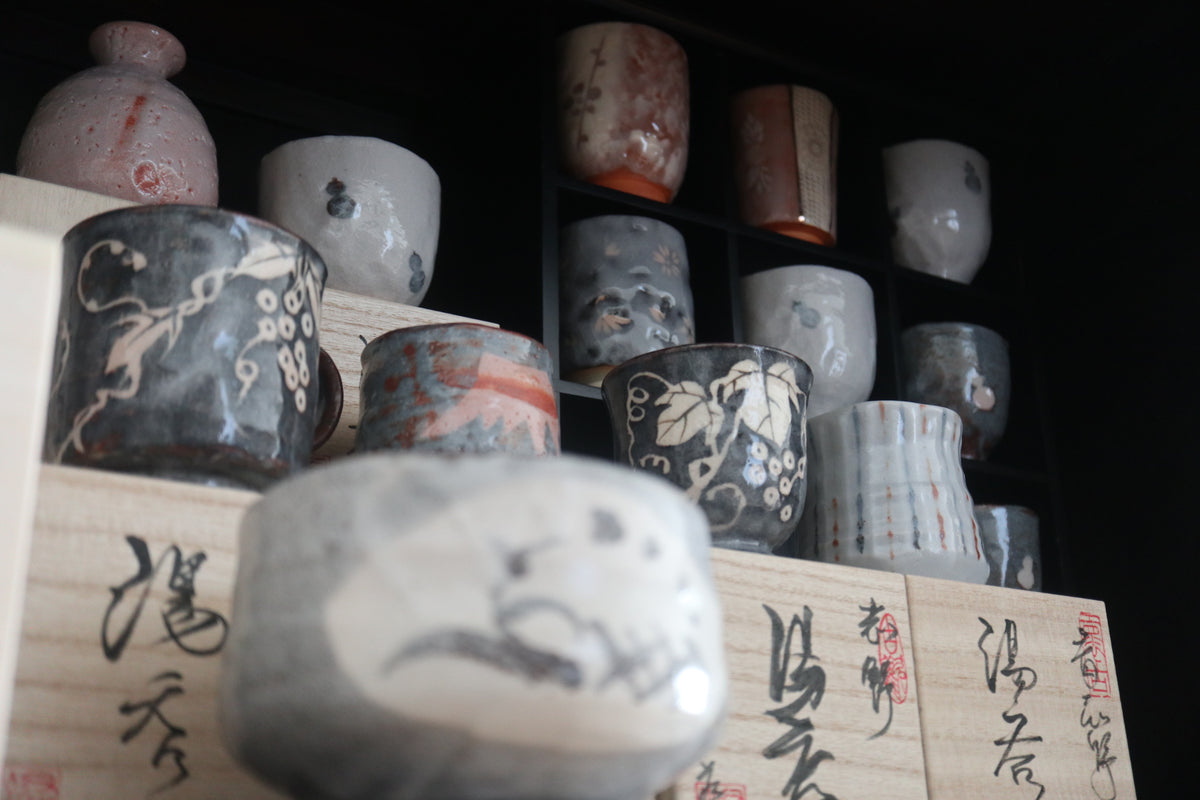
Japanese shino ware white Shino glaze Tea coffee cup auspicious 6 Gourds pattern(come with handmade paulownia wood box and handwriting calligraphy
Japanese shino ware white Shino glaze Tea coffee cup auspicious 6 Gourds pattern(come with handmade paulownia wood box and handwriting calligraphy
Couldn't load pickup availability
Shino ware (white shino) Tea cup coffee cup with traditional Auspicious 6 gourds pattern ,come with handmade paulownia wood box(japanese kanji handwriting calligraphy)
Gourds is the symbol of good fortune and prosperity in east Asia ancient cultures like china and Japan. 6 gourds particularly means protection against disease and prevent disasters.
A rustic yunomi with the quiet warmth of Shino glaze, evoking misty mountains at dawn.
Shino ware is treasured for its thick white glazes, subtle pinholes, and warm blush tones created in the kiln’s fire. This yunomi reflects the Japanese aesthetic of wabi-sabi — simplicity, imperfection, and natural beauty.
When fired in the kiln under strong reduction, the clay turns a vivid red, which is the distinctive feature of Shino ware.
Because of variations in the firing conditions and the way the glaze melts, each piece has a unique appearance, giving every work its own individuality.
This yunomi reflects the Japanese aesthetic of wabi-sabi — simplicity, imperfection, and natural beauty.
more about Shino Ware (志野焼)
Shino ware is among the most important and influential traditions in Japanese ceramics, originating in the late sixteenth century in the Mino region of central Japan. Recognized as Japan’s earliest white-glazed stoneware, it occupies a central position in the development of tea ceramics and the aesthetics of the Momoyama period.
The term “Shino” is believed by scholars to derive from a Chinese name or lineage, and the style itself emerged from experimental efforts by Mino potters to reproduce the highly prized white porcelains imported from China. Rather than achieving true porcelain, these early trials gave birth to a distinctly Japanese form of white stoneware — softly opaque, richly textured, and expressive of natural irregularity.
Shino ware is characterized by thick feldspathic glazes, subtle crackle patterns, and delicate fire markings that record the movement of flame and ash within the kiln. Iron-oxide brush decoration, often depicting grasses, flowers, or abstract motifs, appears gently beneath the translucent glaze, lending each vessel a restrained lyricism.
Highly responsive to the conditions of firing, every Shino piece is inherently unique. Its quiet surface, warm tonality, and tactile presence embody the principles of wabi-sabi and the contemplative spirit of the tea ceremony, inviting close observation and sustained appreciation.
The Shino tradition encompasses several recognized types, including Shiro-Shino (White Shino), Nezumi-Shino (Gray Shino), Aka-Shino (Red Shino), and E-Shino (Painted Shino). Each reflects variations in iron decoration, glaze thickness, and firing atmosphere, resulting in distinct expressions within the same ceramic lineage.
Main Types of Shino Ware (志野焼)
1. Shiro-Shino 白志野 (White Shino)
• The earliest and most fundamental form of Shino
• Thick, milky white feldspar glaze
• Soft surface, pinholes, subtle scorch marks (hi-iro)
• Quiet, tea-ceremony oriented
👉 The spiritual core of Shino ware
⸻
2. Nezumi-Shino 鼠志野 (Gray Shino)
• Decorated with iron slip (onita) beneath Shino glaze
• Designs are carved (sgraffito) before glazing
• Fired to smoky gray or charcoal tones
• Strong contrast between glaze and carved patterns
👉 More graphic and expressive
⸻
3. Aka-Shino 赤志野 (Red Shino)
• Uses the same technique as Nezumi-Shino
• Fired under stronger reduction
• Iron-rich areas emerge as warm red or reddish-brown
• Highly dependent on kiln conditions
👉 Rare, dramatic, and highly prized
⸻
4. Kuro-Shino 黒志野 (Black Shino) (less common)
• Darkened surface due to heavy reduction or iron influence
• Can appear deep brown to near black
• Rustic, powerful presence
👉 Uncommon and often debated among scholars
⸻
5. E-Shino 絵志野 (Painted Shino) (sometimes grouped with Shiro-Shino)
• Iron-oxide brush decoration (plants, grasses, abstract motifs)
• Designs appear softly beneath white glaze
• Often overlaps stylistically with White Shino
👉 Poetic and lyrical
Handwash only.
Special Touch:
Packaged in a paulownia wood box with handwritten calligraphy, and includes a story card explaining the Shino tradition.
Size:
about 290ml
12cmx8cm
shipping from Quebec
Free Japanese style Gift wrapping on request.
Share